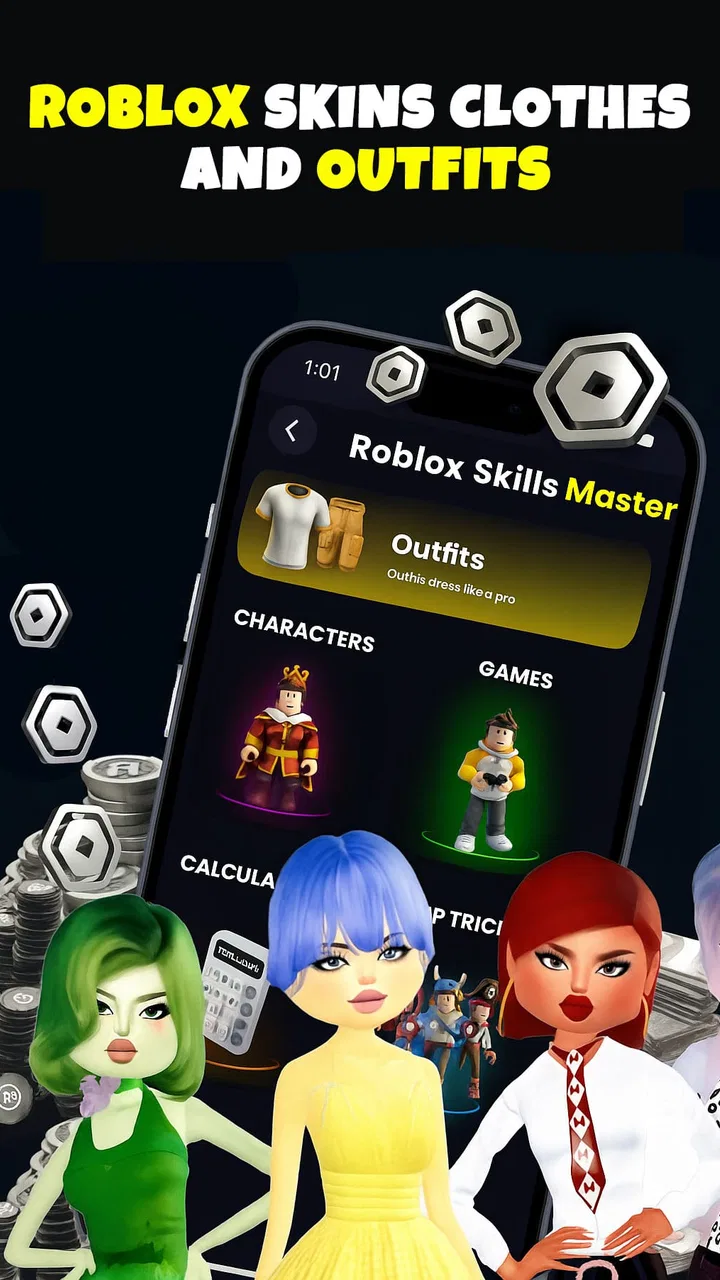
Clothes Skin maker for Roblox
- 5.0
- Rating
- 50.00K
- Installs
- Free
- Price

 Analysis by App-foxy
I approached Clothes Skin maker for Roblox as something that could sit naturally on a shared phone or tablet: one person sketches an outfit idea, another gives an opinion, and the device moves between them without turning the activity into a complicated project. The app belongs to the Libraries & Demo category, is free to use, and is aimed at making clothing skins rather than replacing Roblox itself. That distinction matters from the first minute, because it sets the right expectation: this is a creative companion for outfit design, not a full game or a complete Roblox wardrobe manager.
My first impression was shaped by its narrow purpose. The short description, “Clothes Skin Maker,” is simple, but the actual appeal is more specific: it gives fans who enjoy futuristic, aesthetic clothing a place to work on visual ideas. I can imagine using it while planning a coordinated look, testing a color direction, or making a design concept before deciding whether it is worth taking further. It is especially approachable for someone who wants to experiment without learning a professional graphics program.
How it fits a shared household routine
The most convincing use case is a short, informal session between people who already share an interest in Roblox-style fashion. Picture a child showing a parent a neon jacket concept after school, or siblings passing a tablet between them while choosing whether a design should feel more metallic, minimal, or futuristic. In that situation, the app works less like a solitary production tool and more like a visual conversation starter.
You May Also Like

 Blood Strike: 2.5 Anniversary
Blood Strike’s Loadouts Turn Every Drop Into a Tactical Gamble
A close look at Blood Strike’s custom loadouts: how fast access to signature weapons reshapes its battle royale rhythm, rewards preparation, and narrows the gap between fights.

 Pandora - Music & Podcasts
Pandora’s Music Is Easy to Start, but Harder to Recover
Pandora’s strength is its low-effort path from a seed to a station. Its weak spot is how much confidence it asks you to place in connection, setup, and quiet recovery.

 8 Ball Pool
 Is Built on Rivalries, Rematches, and Routine
A close look at the rivalries, rematches, shared routines, and unanswered safety questions that turn a quick pool match into a persistent mobile community.

 Samsung Music
’s Quiet Strength Is Playing What You Already Own
Its reach comes less from spectacle than from dependable access to a personal library. That simplicity is both the app’s strongest retention engine and its ceiling.

 AccuWeather: Weather Radar
AccuWeather Review: A Quick, Clear Forecast for Everyday Decisions
For everyday plans, the best forecast is the one you can understand quickly. AccuWeather makes rain timing, radar, and local conditions easy to act on, with a few trade-offs.

 Hill Climb Racing
Why Hill Climb Racing Still Turns Crashes Into One More Run
A tiny car, a bumpy hill and one more upgrade: Hill Climb Racing keeps resurfacing because its simple chaos makes every near-miss feel personal.
More From Our News Desk
View All News


I would keep the activity deliberately small. Rather than asking everyone to create a complete collection, I would begin with one clothing idea and one clear theme. A limited brief such as “make a cool space-inspired top” gives the session direction and makes it easier for another household member to offer useful feedback. Without that boundary, design apps can quickly become a cycle of random changes, especially when several people are touching the same screen.
That shared-device scenario also reveals a practical strength: the app’s purpose is easy to explain. A new user does not need to understand a large creative suite before contributing. Someone can look at the design and respond to the visible choices. For families or roommates, that makes it easier to participate even when only one person is especially interested in clothing creation.
There is a trade-off, though. A shared session can become confusing if people do not agree on whose design they are editing. I would use a simple spoken rule: one person is the designer, one person is the reviewer, and the roles change only after a clear handoff. That sounds minor, but it prevents the common problem of a well-intentioned helper changing a detail the original creator wanted to keep.
What I would do before handing over the device
I would start by deciding whether the session is for exploration or for producing a finished-looking idea. Exploration means trying unusual combinations and accepting rough results. A finished concept needs more discipline: a limited palette, a recognizable focal point, and a final check at normal viewing size. Mixing those goals is a quick way to frustrate younger users, because experimentation can look “wrong” when judged as if it were a final outfit.
I would also create a verbal boundary around the Roblox account itself. Clothes Skin maker is a design-focused app, so I would not treat it as a reason to hand over account credentials, private messages, or payment details. If the design is eventually used elsewhere, that should be a separate decision made through the appropriate Roblox tools and account owner. Keeping those stages separate is one of the most useful habits for a shared device.
This separation also answers a question many households have: does using the app mean that a design automatically appears inside Roblox? I would not assume that. I see the app as a place to make or explore clothing concepts, while Roblox remains a separate service with its own account and publishing steps. Anyone expecting an automatic wardrobe update may find the experience less direct than imagined.
For that reason, I would save or record the design process in an organized way if the app offers an output worth keeping, using a household folder or a clearly named device location rather than mixing it with personal documents. I would avoid inventing a complicated filing system. A name based on the creator and theme is enough to prevent confusion when several people share one tablet.
Boundaries that make shared use calmer
Account boundaries matter even when the creative task feels harmless. I would let the younger user work on the visual idea, but I would keep decisions involving publishing, purchases, or account access with the account owner. This is not a criticism of the app; it is a sensible division between designing clothing and managing an online identity.
The age context is also worth considering. The app is rated Everyone, which makes it easy to consider for a broad household audience. Still, an age label does not replace supervision or conversation. A parent may want to explain that a stylish skin concept is not the same thing as permission to share personal information, contact strangers, or move a conversation outside the household’s normal rules.
I would be particularly careful with the phrase “free.” The app itself is free, but that does not mean every surrounding Roblox activity is free or that every design can be used without separate conditions. A child may reasonably interpret a free design tool as a promise that the entire path from idea to in-game item costs nothing. Clarifying that distinction early avoids disappointment and unnecessary purchase requests.
Another useful boundary is time. Creative apps can feel relaxing, but a shared device often has another person waiting for it. I would agree on a short design round, then pause for review. That encourages deliberate choices and makes it easier to hand the device to someone else without the session becoming open-ended.
Working together without losing the original idea
Coordination is where I think the app can be more valuable than its brief store wording suggests. Clothing design is visual, so feedback can be immediate: the reviewer can point to a color, shape, or overall mood instead of trying to describe an abstract idea. That makes it suitable for a parent who is not a Roblox player but still wants to help a child make thoughtful choices.
I would use a three-step conversation. First, the designer explains the intended character or mood. Second, the reviewer mentions one detail that already communicates that intention. Third, the reviewer suggests only one change. Limiting feedback to one change keeps the creator in control and prevents the design from becoming a compromise assembled from everyone’s preferences.
A more advanced workflow is to create variations rather than endlessly modifying a single idea. One version could emphasize bright futuristic colors, another could use a darker palette, and a third could reduce visual clutter. Comparing variations is often more useful than asking whether one design is simply “good.” It also gives siblings a fairer way to contribute when they have different tastes.
I would recommend keeping the design brief visible in conversation: futuristic, sporty, soft, dark, or whatever theme the creator chose. This prevents a common drift where each new suggestion sounds interesting but pulls the outfit away from its original identity. In my experience, a strong theme is more useful than adding more decoration.
There is also a household coordination benefit in assigning different jobs. One person can focus on the main clothing idea, another can watch for color balance, and a third can act as the final audience. Those roles should rotate, because the person giving feedback may learn more by designing the next variation. The app is best suited to this lightweight collaboration, not to a formal multi-user production pipeline.
That limitation is important for anyone expecting team features. I would not assume that several people can edit simultaneously, leave structured comments, or maintain separate project histories inside the app. If a household needs those tools, a general-purpose design platform may be more appropriate. Clothes Skin maker’s appeal is its focused, approachable purpose, not project management.
Tips for making designs easier to judge
One non-obvious tip is to review the outfit at a distance rather than staring only at individual details. A design can look impressive when zoomed in but lose its identity when viewed as a whole. I would ask: can I recognize the main idea quickly, and does the focal detail still stand out when the rest of the clothing is visible?
I would also test restraint. Futuristic styling often tempts creators to add bright accents everywhere. A stronger result may come from choosing one dominant color, one supporting color, and a small highlight. That approach makes the design easier to recognize and gives shared reviewers a concrete reason for their suggestions.
Another useful habit is to compare the design with the avatar or character style it is meant to support. A clothing skin should not be judged only as a flat image. The question is whether its shapes and colors still make sense when combined with the rest of the look. This is where the app can help with ideas, but the final decision should happen in the context where the outfit will actually be seen.
I would keep an “experimental” version separate from the “best so far” version. That simple distinction protects a promising design from being lost during a risky change. On a shared device, it also lets another person try a bold idea without overwriting the creator’s preferred direction.
Trust, privacy, and age-appropriate use
Because the app is suitable for Everyone, I can see why it may attract younger users. The visual task is easier to understand than a complex editing program, and the subject is familiar to Roblox fans. Even so, I would introduce it as a creative activity rather than as a route to popularity, rare items, or contact with other players.
For a child using a household tablet, I would make the account owner clear before the first session. The person creating the clothing idea and the person responsible for Roblox activity may be different people. That distinction helps avoid accidental changes to someone else’s profile and teaches a useful digital habit: creative access does not automatically equal account ownership.
I would also review any sharing decision together. A design may feel personal even when it contains no obvious private information, particularly if it represents a child’s nickname, favorite group, or recognizable style. The safest approach is to decide what stays on the device, what may be shown to family, and what—if anything—should be used publicly.
The developer is KOUSSI, and the app has built a strong visible audience, with an average rating of 5.0 from over 500 ratings and more than 50 thousand installs. Those figures suggest that the focused concept resonates with users, but I would still treat popularity as a starting point rather than proof that it suits every household. A high rating cannot tell me whether a particular child wants open-ended drawing, direct in-game publishing, or advanced editing controls.
The age rating helps with initial screening, but I would still stay nearby for a first session, especially on a shared device. The goal is not to monitor every creative choice. It is to make sure the child understands which activity belongs to the app, which belongs to Roblox, and which decisions require an adult or account owner.
Performance expectations and practical fit
The current version is 4.0, and the app can be used on devices running Android 7.0 or later. That makes it a realistic candidate for an older household phone or tablet that is no longer used as someone’s primary device. Before installing, I would still check that the device has enough free space and that its screen is comfortable for visual work; a small or badly calibrated display can make clothing details harder to judge.
I would not choose this app for someone who wants a full fashion design workstation. Its strength is focus. If the user needs layers, detailed retouching, typography, animation, or a broad export workflow, a general drawing application will probably offer more control. That extra control comes with a steeper learning curve, so the better option depends on whether the priority is quick Roblox-oriented experimentation or professional-style editing.
It also may not satisfy a user whose main goal is immediate gameplay. This is not a substitute for Roblox, and it should not be presented to a child as one. It belongs beside the game, in the planning and styling part of the experience. That makes it a good fit for players who enjoy appearance and customization, but a weak fit for someone who only wants action, exploration, or social play.
Compared with browsing ready-made clothing, creating a skin requires more patience but gives the user a stronger sense of ownership over the idea. Browsing is faster when the goal is simply to find an outfit. This app is better when the user wants to make choices, compare directions, and develop a personal visual style. I would use the two approaches at different stages rather than treating them as direct replacements.
Compared with a blank canvas, the Roblox clothing focus provides a clearer destination. A blank drawing app may be more flexible, but it can leave a beginner wondering what to make or how to judge the result. Clothes Skin maker narrows the task in a helpful way. The downside is that users who outgrow that narrow format may quickly want tools the app was never designed to provide.
Who should use it and who should skip it
I would recommend it to a Roblox fan who enjoys outfit concepts, a younger creator who benefits from a focused activity, or a household looking for a simple shared design session. It is also a reasonable choice for someone who wants to explore futuristic aesthetics without committing to a complex art program.
I would be more cautious about recommending it to a serious digital artist, a creator who needs precise production controls, or anyone expecting automatic account integration. Those users may save time with a broader design tool or with Roblox’s own established creation and publishing workflow, depending on the exact project.
I would also skip it for a household that cannot agree on device and account boundaries. The app can support cooperation, but it cannot replace clear rules about ownership, sharing, purchases, or public posting. Those decisions belong to the people managing the device and the relevant accounts.
For a realistic routine, I would set aside one short session, choose a single theme, make two or three variations, and finish by selecting one favorite detail rather than demanding a perfect final outfit. That workflow keeps the activity enjoyable and produces a useful result even if the design never becomes an in-game item.
My household verdict
After looking at it through a shared-device lens, I see Clothes Skin maker as a focused creative companion with a clear audience. It is free, accessible to an Everyone-rated audience, and simple enough to bring into a family design conversation. Its strongest quality is not that it tries to do everything; it is that it gives Roblox clothing ideas a defined place to develop.
The main friction comes from expectations. Users should understand the difference between designing a skin concept and managing a Roblox account, and families should decide in advance who controls sharing or purchases. People wanting advanced editing, collaborative project history, or a direct gameplay experience should choose something else.
For me, the app earns a recommendation when the goal is a short, friendly design session on a shared phone or tablet. I would hand it to a young Roblox fan with an agreed theme, a clear device boundary, and an adult available for account-related decisions. Used that way, it turns clothing customization into a manageable creative activity rather than another source of household confusion.
FAQs for Clothes Skin maker for Roblox
01What is Clothes Skin Maker for Roblox?
Clothes Skin Maker for Roblox is an app that allows users to design and customize their own clothing and skins for their Roblox avatars. It provides a variety of tools and templates for creating unique outfits, enabling users to express their creativity and enhance their gaming experience on the Roblox platform.
02How user-friendly is the app for beginners?
The app is designed with beginners in mind, offering an intuitive interface and easy-to-follow tutorials. It includes step-by-step guides and pre-made templates to help new users quickly get started with designing their own Roblox clothes and skins, making it accessible even for those with no prior design experience.
03Does the app offer any in-app purchases or ads?
Yes, Clothes Skin Maker for Roblox contains in-app purchases and may display ads. These purchases typically unlock premium features or additional design elements, enhancing the user's creative options. While the core features are accessible for free, users can opt to purchase additional content to expand their design capabilities.
04Is the app compatible with all devices?
The app is compatible with most Android and iOS devices, but it's always best to check the specific system requirements on the app store page to ensure compatibility with your device. Regular updates are made to optimize performance and add features, so keeping your app up-to-date is recommended for the best experience.
05Can I use my designs directly in Roblox?
Yes, once you've created your design in Clothes Skin Maker for Roblox, you can upload it to Roblox, provided you have a Builder's Club membership. This allows you to use your custom designs in the game. The app provides a straightforward process for exporting and uploading your creations to your Roblox account.
Pros
- User-friendly interface with intuitive tools.
- Wide variety of customization options available.
- Regular updates with new templates and features.
- Supports high-resolution skin exports.
- Great for both beginners and advanced users.
Cons
- Contains in-app purchases for premium features.
- Occasional ads can interrupt the experience.
- Limited free template options available.
- Requires internet connection for some features.
- May have compatibility issues on older devices.

Clothes Skin maker for Roblox
Gallery